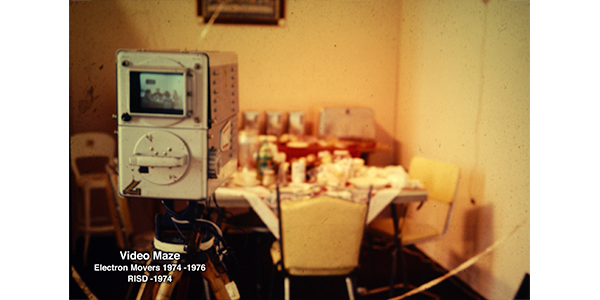
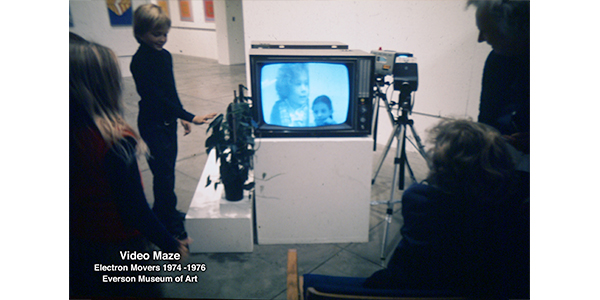
The Video Maze was an interactive installation first exhibited at the Everson Museum of Art that expanded existing parameters of multi-channel video installation by mixing both live and pre-recorded video into a single show. It developed into a travelling show that ran at the Currier Museum of Art and Gallery Manchester NH, Wooster Art Museum, and University of Massachusetts art galleries. Parts of the installation were included in the Avant Garde Festival of New York, founded by Charlotte Moorman.
Alan Powell and Laurie McDonald spent fall of 1973 working with VideoFreex and Shirley Clark’s Tee Pee Video Space Troupe at Bucknell University, pioneering video art collectives known for video projects/documentaries on counterculture and the societal upheaval and liberation movements defining the 1970s through an artistic lens. Powell and McDonald would pull from their experience working with interactive video installations during this time to build out those actual convoluted pathways and rooms of the maze, as well as the perceptual elements made possible through viewer participation in video spaces. The Electron Movers, including Alan and Laurie McDonald’s experience as solo artists, had before mounted multi-channel installations, but always using either live or pre-recorded images. The Video Maze, complete with eight suites bordered by video mixing technology and recording equipment, integrated both live and pre-recorded images. The exhibit boldly transported its participants between two- and three-dimensional spaces, broadcasting them on the very monitors that walled them in.
Returning to RISD in 1974, Alan and Laurie McDonald took a “Dance Video Class” headed by Dorothy Jungels. The roster was comprised of Electron Movers members: Dennis Hlynsky, Ed Tannenbaum and Jamie Daglish; the class initiating a collaborative dynamic that would evolve into the Electron Movers collective stage. In the course, members began to conceptualize an interactive video space that incorporated the viewer herself into its end product.
Rhode Island School of Design engineer John Fiore modified old broadcast cameras porta-pc video to be able to playback or record as well as retrofitting them so Powell, McDonald, and the other members could “flip” images from a live camera feed upside down or horizontally during the show. Sound was taken from within the installation, the recordings sent to loudspeakers elsewhere in the gallery to create the aural equivalent of catching those bouncing, scattered reflections that follow you through a room full of mirrors.
Modules developed throughout spring of 1974 trifurcated the Maze into sections that represented the Electron Movers’s three creative disciplines: installation, dance/performance, and a tape-based straight video showing.
The installation was adjusted based on available equipment, and the ability of galleries/museums to maintain the installation’s structure. For the 1974 Video Maze, McDonald used hydrophones, or underwater microphones, to record audio of participants bobbing for apples. In the Everson and University of Massachusetts shows, Ed Tannenbaum rigged plastic ducks to play stretched out guitar strings that were wired to amplifiers.

Video Maze, Everson Museum of Art, 1975 Thermins -Powell Video Room Hynsky

Video Maze: RISD 1974 Electron Movers launch

Everson Museum

Electron Movers at Umass 1977
Electron Movers at Umass 1977
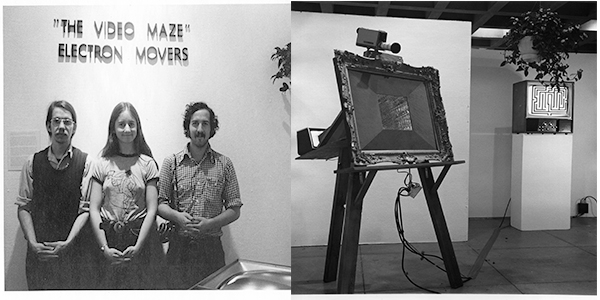
Electron Movers-video Maze-videola-1975-Everson
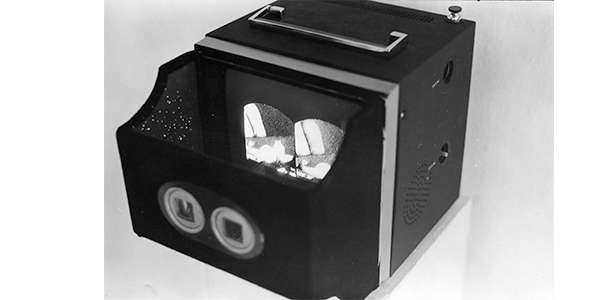
electronmovers-videomaze-stereotv-dh-1975-everson-web
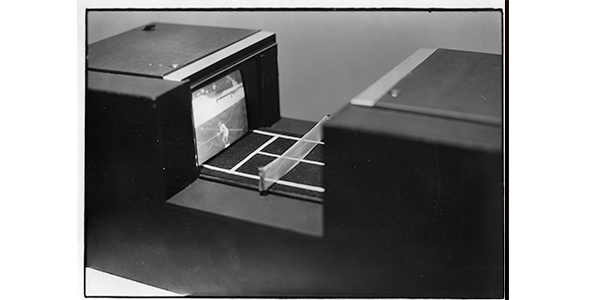
electronmovers-videomaze-dh-tennis-1975-everson-web
Electron Movers – Installations 1974 – 1978
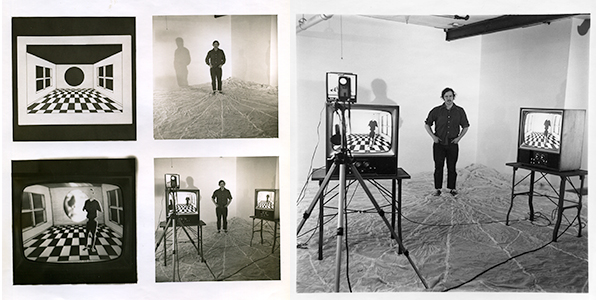
Electron Movers videomaze 1975-video room Dennis Hlynsky
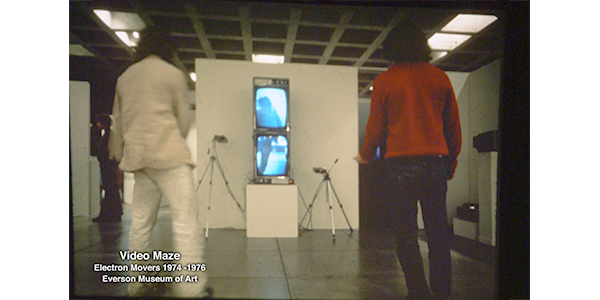
electron Movers-videomaze 1975 Everson Museum